Weight loss medication comparison

Zepbound vs Wegovy: Which Weight Loss Medication Works Better?

A medically reviewed comparison of effectiveness, mechanisms, side effects, costs, coverage, eligibility, and treatment fit.

Reviewed & Approved By
Dr. Fremlin Dekyi, MD

Dr. Fremlin Dekyi, MD

Board-certified Family Medicine Physician

Medical Reviewer, Doko Medical

  • Evidence-Based Review
  • Clinical Accuracy Verified
  • Reviewed for Weight Loss Medication Education
Zepbound vs Wegovy: Which Weight Loss Medication Works Better?
Medical Review Statement

This article has been medically reviewed and approved by Dr. Fremlin Dekyi, MD, to support clinical accuracy and patient-friendly education about Zepbound and Wegovy. It is educational and does not replace individualized medical advice.

Quick Answer

Which works better for weight loss: Zepbound or Wegovy?

In a direct 72-week clinical trial of adults with obesity but without diabetes, tirzepatide produced greater average weight loss than semaglutide at the maximum tolerated doses studied. Zepbound contains tirzepatide and Wegovy contains semaglutide. The best choice still depends on medical history, treatment goals, side-effect tolerance, coverage, cost, availability, and provider recommendations.

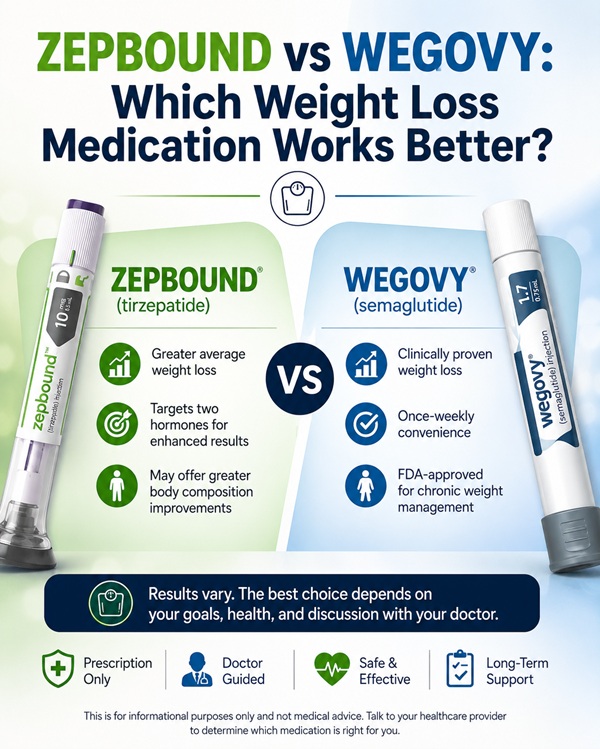
Zepbound and Wegovy are once-weekly injectable medications FDA-approved for chronic weight management in eligible patients. Both reduce appetite and support greater fullness, but they contain different active ingredients and act through different hormone pathways.

Zepbound contains tirzepatide, a dual GIP and GLP-1 receptor agonist. Wegovy contains semaglutide, a GLP-1 receptor agonist. Both can be highly effective when combined with an appropriate nutrition, activity, and follow-up plan.

Clinical Evidence

Clinical Evidence: Zepbound vs Wegovy

Separate pivotal trials and a direct head-to-head trial provide evidence about average weight-loss outcomes. Trial populations, methods, doses, and duration matter when interpreting the results.

SURMOUNT-5 Head-to-Head Trial

SURMOUNT-5 directly compared tirzepatide with semaglutide in adults with obesity but without diabetes. At 72 weeks, average body-weight change was approximately -20.2% with tirzepatide and -13.7% with semaglutide at the maximum tolerated doses used in the study.

This direct evidence supports greater average weight reduction with tirzepatide in the population studied. It does not guarantee that every patient will lose more weight with Zepbound.

SURMOUNT-1 and STEP 1

In SURMOUNT-1, tirzepatide produced average weight reductions of roughly 15% to 21% over 72 weeks depending on dose. In STEP 1, semaglutide 2.4 mg produced about 15% average weight reduction over 68 weeks.

Because these were separate trials, their results should not be treated as a direct comparison; SURMOUNT-5 provides the stronger comparative evidence.

Zepbound vs Wegovy at a Glance

Both medications are weekly injections approved for chronic weight management in eligible patients. Their active ingredients, receptor activity, dose schedules, and additional approved indications differ.

Feature Zepbound Wegovy
Active ingredient Tirzepatide Semaglutide
Receptor activity GIP and GLP-1 GLP-1
Chronic weight-management approval Yes Yes
Administration Once-weekly injection Once-weekly injection
Appetite reduction Yes Yes
Prior authorization Common Common
Cash cost Typically high; verify current price Typically high; verify current price

Zepbound Dosage vs Wegovy Dosage

Understanding the difference between Zepbound dosage and Wegovy dosage can help patients set realistic expectations about treatment progression. Both medications use gradual dose escalation to help reduce side effects while allowing the body to adjust.

Although both medications are taken once weekly, their dosing schedules differ because they contain different active ingredients. Zepbound contains tirzepatide, while Wegovy contains semaglutide.

Zepbound dosage Wegovy dosage
2.5 mg 0.25 mg
5 mg 0.5 mg
7.5 mg 1.0 mg
10 mg 1.7 mg
12.5 mg 2.4 mg
15 mg Maximum Wegovy dose reached

How Dose Escalation Works

Most patients begin with the lowest dose and gradually increase about every four weeks if tolerated. The purpose of dose escalation is not only to improve effectiveness but also to minimize common gastrointestinal side effects such as nausea, vomiting, diarrhea, and constipation.

Zepbound starts at 2.5 mg weekly and may be increased gradually to 5 mg, 7.5 mg, 10 mg, 12.5 mg, and 15 mg. The maximum approved Zepbound dosage is 15 mg weekly.

Wegovy starts at 0.25 mg weekly and typically increases through 0.5 mg, 1.0 mg, 1.7 mg, and 2.4 mg. The maximum approved Wegovy dosage is 2.4 mg weekly.

  • Many patients notice appetite suppression before reaching the highest dose.
  • Greater average weight loss is often observed at higher maintenance doses.
  • The best dose is the dose that is effective and well tolerated for the individual patient.
  • Dose decisions should be made with a licensed healthcare provider.

Does a Higher Dose Mean Better Results?

Not necessarily. Clinical studies often show greater average weight loss at higher maintenance doses, but that does not mean every patient needs the highest available dose.

Some patients achieve excellent results at lower doses, while others require full maintenance dosing to achieve meaningful weight reduction. A provider can monitor effectiveness, side effects, hydration, nutrition, and overall health before adjusting treatment.

Weight Loss Timeline Comparison

Many patients ask how fast Zepbound works compared with how fast Wegovy works. Individual results vary, but the timeline below shows common treatment expectations as dose escalation continues.

Timeline Zepbound Wegovy
Month 1 Most patients are still on the 2.5 mg starter dose. Weight loss is often modest, with reduced appetite, smaller portions, fewer cravings, and early weight loss for some patients. Most patients are on the 0.25 mg starter dose. The goal is adjustment, with reduced hunger, increased fullness, better portion control, and initial weight reduction for some patients.
Month 3 Patients have often advanced to higher doses and may notice more consistent appetite suppression, improved eating habits, reduced cravings, and more visible weight change. Many patients begin seeing meaningful weight reduction, improved satiety, better dietary adherence, steady weekly progress, and increased motivation.
Month 6 Many patients have reached maintenance dosing. Meaningful body-weight reduction may occur by this stage, especially with nutrition and activity improvements. Many patients have reached higher maintenance dosing and may continue losing weight steadily. Lifestyle habits become increasingly important.
Month 12 Many patients achieve substantial weight reduction. Trial data show average weight loss that exceeds many older obesity medications. Many patients achieve meaningful improvements in weight, blood pressure, metabolic health, and physical activity tolerance.

Which Medication Works Faster?

Some evidence suggests Zepbound may produce greater average weight loss over time, but individual response varies significantly. Consistency matters more than short-term speed when evaluating long-term weight-loss success.

The medication that works best is the one that produces sustainable results, has manageable side effects, is affordable, is covered when possible, and fits the patient's medical history.

What Is Zepbound?

Zepbound contains tirzepatide, which activates both GIP and GLP-1 receptors. This dual action influences appetite, fullness, calorie intake, blood sugar, and metabolic health.

Zepbound is FDA-approved for chronic weight management in eligible patients and has an additional approved indication for moderate-to-severe obstructive sleep apnea in adults with obesity.

What Is Wegovy?

Wegovy contains semaglutide, a GLP-1 receptor agonist that supports fullness, reduces appetite, and slows gastric emptying.

Wegovy is FDA-approved for chronic weight management in eligible patients and to reduce certain major cardiovascular risks in qualifying adults with established cardiovascular disease and overweight or obesity.

Which Medication Produces More Weight Loss?

On average, tirzepatide produced greater weight reduction than semaglutide in the direct SURMOUNT-5 trial. Individual response can differ substantially, and the maximum tolerated dose, treatment adherence, side effects, and duration all influence outcomes.

Evidence Tirzepatide / Zepbound Semaglutide / Wegovy
SURMOUNT-5 average change at 72 weeks Approximately -20.2% Approximately -13.7%
Pivotal separate-trial range Approximately 15%-21% in SURMOUNT-1 Approximately 15% in STEP 1
Important note Individual results vary Individual results vary

Weight Loss Examples

The examples below show what 15% and 20% of starting body weight equal. They illustrate percentages and are not promised outcomes for either medication.

Starting weight 15% of body weight 20% of body weight
200 lbs 30 lbs 40 lbs
250 lbs 37.5 lbs 50 lbs
300 lbs 45 lbs 60 lbs

How Zepbound Works

Tirzepatide activates GIP and GLP-1 receptors. Researchers believe this dual mechanism contributes to appetite regulation, reduced calorie intake, weight loss, and metabolic improvements.

  • Supports earlier fullness
  • May reduce food cravings
  • Helps lower calorie intake
  • Influences glucose-dependent insulin response

How Wegovy Works

Semaglutide activates GLP-1 receptors. It reduces appetite, increases fullness, slows gastric emptying, and can help patients consume fewer calories.

  • Increases satiety
  • May reduce appetite
  • Slows gastric emptying
  • Supports lower calorie intake

Side Effects Comparison

Both medications commonly cause gastrointestinal symptoms, especially during dose escalation. Symptoms may improve with time, but patients should contact their care team about severe, persistent, or concerning effects.

Both labels include important warnings, contraindications, and a boxed warning concerning thyroid C-cell tumors. Product-specific prescribing information should be reviewed before treatment.

Potential side effect Zepbound Wegovy
Nausea Common Common
Vomiting May occur May occur
Diarrhea Common Common
Constipation Common Common
Abdominal discomfort May occur May occur

Which Medication Has Fewer Side Effects?

There is no universal answer. Dose-escalation speed, individual tolerance, diet, hydration, medical history, and other medications can affect tolerability. Some patients tolerate Wegovy better, while others tolerate Zepbound better.

Cost Comparison

Cash prices for both medications can be high. Actual out-of-pocket costs depend on pharmacy pricing, insurance benefits, deductibles, prior authorization, manufacturer savings eligibility, dose, and location.

Patients should verify live prices and coverage rather than relying on a fixed online estimate. The less expensive option varies from person to person.

Insurance Coverage Comparison

Coverage for either medication may require BMI documentation, qualifying conditions, medical-necessity review, prior authorization, or step therapy. A patient may meet medical eligibility criteria while still having no obesity-medication benefit.

Common requirement Zepbound Wegovy
BMI documentation Common Common
Weight-related condition documentation May be required May be required
Prior authorization Frequently required Frequently required
Medical-necessity review Common Common
Plan obesity benefit Often decisive Often decisive

Zepbound and Wegovy Insurance Details

Zepbound insurance coverage varies widely between plans. Many commercial insurers require BMI documentation, weight-related health conditions, prior authorization, and medical-necessity review.

Wegovy insurance coverage is often similar and may be available through a larger number of plans because it has been on the market longer. Approval commonly depends on BMI requirements, comorbid conditions, prior authorization, and documentation of previous weight-loss efforts.

Major insurers such as Aetna, Blue Cross Blue Shield, UnitedHealthcare, and Cigna may cover one or both medications under certain plans, but employer-sponsored plans can still exclude obesity medications. Patients should verify benefits directly with their insurer.

Coverage factor Why it matters
BMI documentation Insurers often require current height, weight, and BMI records.
Weight-related health conditions Conditions such as hypertension, sleep apnea, high cholesterol, prediabetes, or type 2 diabetes may support approval.
Prior authorization A provider may need to submit records before the plan approves payment.
Employer benefit design Some employer plans exclude weight-loss medications even when pharmacy benefits exist.
Medicare limitations Medicare generally has limited coverage for medications prescribed solely for weight loss, although rules may evolve.

Zepbound vs Wegovy: Who Is More Likely to Get Insurance Approval?

Insurance approval is one of the most important factors when choosing between Zepbound and Wegovy. Even if a medication is medically appropriate, coverage can determine whether treatment is affordable.

There is no universal approval winner. Most insurance companies evaluate the patient's plan benefits, BMI, health conditions, prior authorization paperwork, and medical-necessity documentation before approving weight-loss medication.

Common approval factor Why insurers review it
Current BMI Plans often require BMI documentation before authorizing obesity medication coverage.
Weight-related medical conditions Conditions such as high blood pressure, sleep apnea, prediabetes, type 2 diabetes, or high cholesterol may support medical necessity.
Previous weight-loss attempts Some plans request documentation of prior nutrition, activity, or lifestyle efforts.
Medical-necessity documentation Provider notes may need to explain why treatment is clinically appropriate.
Prior authorization requirements Incomplete or missing forms commonly delay or prevent approval.
Employer plan benefits Some plans exclude obesity medications even when a patient meets clinical criteria.

Insurance Approval Examples

The examples below are educational only and do not guarantee approval. Actual coverage depends on the patient's insurance plan, diagnosis, documentation, and provider review.

Example patient Possible insurance discussion
BMI 32 with hypertension and previous diet/exercise attempts May qualify for either Zepbound or Wegovy if the plan includes obesity medication benefits and documentation is complete.
BMI 28 with obstructive sleep apnea May qualify depending on the medication, insurer requirements, weight-related condition documentation, and plan rules.
BMI 42 with hypertension and prediabetes Often has a stronger medical-necessity case because obesity-related complications are present.

Why Some Patients Get Denied

Insurance denial does not always mean the medication is medically inappropriate. A denial may occur because of missing documentation, plan exclusions, incomplete paperwork, or unmet plan-specific requirements.

Many denials can be appealed with additional documentation, but appeal options depend on the plan and the reason for denial.

  • Missing BMI documentation
  • No obesity medication benefit
  • Incomplete prior authorization
  • Insufficient medical records
  • Failure to meet plan requirements
  • Medication not on formulary or not preferred by the plan

BMI Eligibility for Zepbound and Wegovy

Patients frequently ask what BMI is needed for Zepbound or what BMI qualifies for Wegovy. Eligibility must be determined by a healthcare provider, but general chronic weight-management criteria commonly include BMI 30 or higher, or BMI 27 or higher with at least one weight-related condition.

Examples of weight-related conditions include high blood pressure, high cholesterol, sleep apnea, prediabetes, type 2 diabetes, and cardiovascular disease.

Height Weight Approximate BMI
5'5" 180 lbs 30
5'7" 190 lbs 29.8
5'10" 210 lbs 30.1
6'0" 225 lbs 30.5

Higher BMI Patients

Patients with BMI 35 or higher, or BMI 40 or higher, often discuss more aggressive weight-loss goals with their providers. Higher BMI can also strengthen medical-necessity documentation when obesity-related complications are present.

Because Zepbound demonstrated greater average weight loss in comparative research, some providers may discuss tirzepatide when substantial weight reduction is a priority. That discussion still needs to include safety, coverage, side effects, access, and long-term treatment planning.

Cost and Out-of-Pocket Comparison

Without insurance, both medications can be expensive. Monthly costs may reach several hundred to more than one thousand dollars depending on pharmacy pricing, availability, dose, and location.

With insurance coverage, patients may pay less through copays, coinsurance, or deductible-based pricing. Manufacturer savings programs may also help eligible commercially insured patients, but eligibility rules can change.

Some patients may find lower pricing through mail-order pharmacies or preferred pharmacy networks. Current pricing should always be verified before making a treatment decision.

Cost factor How it can affect the patient
Cash price Can be high for both Zepbound and Wegovy without coverage.
Deductible Patients may pay more until the deductible is met.
Copay or coinsurance Final cost depends on the plan structure.
Savings programs May reduce costs for eligible commercially insured patients.
Pharmacy network Preferred or mail-order pharmacies may change the final price.
Availability Supply and pharmacy access can affect where patients can fill prescriptions.

Zepbound vs Wegovy: Side-by-Side Winner Comparison

Many patients want a simple answer, but each medication has different strengths. The practical winner may be the medication that is clinically appropriate, tolerated, available, and covered by the patient's plan.

Category Winner or practical takeaway
Average weight loss Zepbound
Cardiovascular evidence Wegovy
Long-term market experience Wegovy
Obstructive sleep apnea indication Zepbound
Insurance availability Depends on plan
Appetite reduction Tie
Once-weekly dosing Tie
GI side effects Tie
Severe obesity discussion Zepbound may be discussed because of stronger average weight-loss data
Overall convenience Tie

Which Medication May Be Better for Different Patients?

The best medication is rarely determined by weight loss alone. Safety, affordability, insurance coverage, side-effect tolerance, medical history, and long-term sustainability all play important roles.

Patient priority Medication discussion point
Maximum average weight loss is the main goal A provider may discuss Zepbound because tirzepatide showed greater average weight loss in direct comparative evidence.
Existing coverage already favors Wegovy Wegovy may be more practical when insurance approval and access are already in place.
Cardiovascular risk reduction is important Wegovy has a distinct cardiovascular risk-reduction indication for qualifying adults.
BMI is above 40 or weight-loss goals are substantial A provider may review tirzepatide data while still considering safety, tolerability, and access.
Prior positive experience with semaglutide Wegovy may be familiar if semaglutide was previously effective and tolerated.
Complex medical history A provider should review diabetes, kidney disease, gallbladder disease, pancreatitis history, severe gastrointestinal conditions, and current medications.

Who May Qualify?

For chronic weight management, adults commonly qualify with a BMI of 30 or higher, or a BMI of 27 or higher with at least one weight-related condition. The products also have pediatric or additional indications with product-specific requirements.

Examples of relevant conditions can include high blood pressure, dyslipidemia, type 2 diabetes, sleep apnea, or cardiovascular disease. A licensed provider must confirm current label criteria and individual suitability.

Which Is Better for Diabetes?

Zepbound and Wegovy are not the brand products approved specifically for type 2 diabetes. Tirzepatide is marketed as Mounjaro for type 2 diabetes, while semaglutide is marketed as Ozempic for type 2 diabetes.

Patients with diabetes and obesity need an individualized plan that considers glucose control, weight goals, cardiovascular and kidney risk, medication duplication, and insurance coverage.

Physician Perspective: How Clinicians Often Choose Between Zepbound and Wegovy

Medical providers rarely choose a medication based on one factor alone. They usually weigh expected benefit, medical history, side effects, approved indications, cost, coverage, access, and the patient's ability to stay on treatment long term.

How much weight does the patient need to lose?

Patients seeking substantial weight reduction may discuss tirzepatide because of its strong weight-loss data.

Does insurance cover one medication?

Coverage often becomes a deciding factor. A medication that costs hundreds less per month may be the better practical option.

Are there cardiovascular concerns?

Patients with obesity and established cardiovascular disease may discuss Wegovy's cardiovascular indication with their provider.

Has the patient used a similar medication before?

Previous experience matters. A patient who previously tolerated semaglutide well may prefer Wegovy, while a patient with limited results may discuss alternatives.

Can the patient maintain treatment long term?

Long-term adherence is often more important than short-term weight loss. The best medication is the one the patient can safely continue while maintaining healthy lifestyle habits.

Patient Scenarios

These fictional examples illustrate how treatment discussions may differ. They are not predictions or prescribing recommendations.

Scenario 1: BMI 38 Without Diabetes

A patient weighing 250 pounds with a BMI of 38 may be eligible for either medication. Expected benefit, tolerability, coverage, and personal priorities help guide the decision.

Scenario 2: BMI 33 With Prediabetes

Both products may be considered after medical review. Insurance coverage and product-specific risks may become deciding factors.

Scenario 3: BMI 42 With Significant Weight-Loss Goals

A provider may discuss tirzepatide’s greater average weight loss in comparative evidence while also reviewing safety, access, sustainability, and the patient’s complete medical history.

Real-World Patient Selection Examples

These examples show how insurance coverage, BMI, health conditions, and prior medication experience can shape the discussion. They are educational only and are not treatment recommendations.

Patient profile Possible discussion
BMI 31 with hypertension and insurance covers Wegovy Wegovy may be practical because coverage already exists.
BMI 43 with prediabetes and a significant weight-loss goal A provider may review Zepbound because of stronger average weight-loss outcomes.
BMI 35 with established cardiovascular disease Wegovy's cardiovascular indication may become an important consideration.
BMI 38 with previous semaglutide intolerance A provider may discuss whether another option is appropriate.

Which Is the Best Weight Loss Medication?

Zepbound produced greater average weight loss in direct comparative evidence, while Wegovy remains highly effective and has extensive clinical evidence plus a distinct cardiovascular risk-reduction indication for qualifying adults.

The best medication is not determined by average weight loss alone. It should align with the patient’s medical history, approved indication, goals, tolerability, access, budget, and provider recommendations.

Key Zepbound vs Wegovy takeaways

  • Zepbound contains tirzepatide and activates GIP and GLP-1 receptors.
  • Wegovy contains semaglutide and activates GLP-1 receptors.
  • Tirzepatide produced greater average weight loss than semaglutide in the direct SURMOUNT-5 trial population.
  • Both medications can cause gastrointestinal side effects and have important warnings and contraindications.
  • Coverage, affordability, safety, and individual treatment goals can matter as much as average trial results.
Best next step

Use consultation to turn search intent into a real treatment decision

Patients usually get more value from medical review, fit assessment, and follow-up planning than from choosing a medication based only on headlines or social posts.

Frequently asked questions

In a direct obesity trial, tirzepatide produced greater average weight loss than semaglutide at the maximum tolerated doses studied. Individual response still varies.

Some patients notice appetite changes early, but there is no guaranteed timeline. Dose escalation and individual response differ.

Both medications have substantial safety data and product-specific risks. Safety depends on the patient’s health history, contraindications, other medications, and response.

Cash prices are often high for both. The less expensive option depends on current pharmacy pricing, insurance, deductibles, and savings eligibility.

Some plans cover Zepbound when authorization criteria are met, while others exclude obesity medications.

Coverage depends on the specific plan, indication, obesity benefit, and authorization criteria.

Only under provider supervision. A clinician must plan timing and dose selection and review side effects and contraindications.

There is no universal answer. Nausea can occur with either medication, particularly during dose escalation.

Tirzepatide has produced greater average weight loss in comparative evidence, but an individual choice requires a complete medical and access review.

Choose with a qualified healthcare provider after reviewing indications, benefits, risks, side effects, goals, coverage, cost, and availability.

Yes, but only under medical supervision. A provider can determine timing, dose selection, and whether switching is appropriate.

Both medications may cause constipation, and individual experiences vary. Hydration, fiber intake, dose changes, and medical history can affect symptoms.

Approval depends on the specific insurance plan, employer benefit design, BMI documentation, qualifying conditions, and prior authorization requirements.

Some patients require ongoing treatment to help maintain results. Stopping treatment should be discussed with a provider because weight regain can occur.

Alcohol may worsen gastrointestinal side effects for some patients and may affect eating patterns or blood sugar. Patients should discuss alcohol use with their provider.

Yes. Appetite reduction and increased fullness are common effects of both treatments.

Lifestyle improvements remain important. Nutrition, activity, sleep, hydration, and follow-up care can improve long-term outcomes.

Many insurance plans require prior authorization for Zepbound or Wegovy before coverage is approved.

Both have substantial research. Semaglutide has been available longer, while tirzepatide has strong obesity trial data and direct comparative evidence.

Ongoing treatment may help support long-term weight management for some patients, but the maintenance plan should be individualized.

Some patients discuss switching because tirzepatide produced greater average weight loss in comparative research. A provider should determine whether switching is appropriate.

Both medications reduce appetite, although individual response varies.

Weight regain may occur after discontinuation, so maintenance planning and follow-up are important.

Weight reduction may improve metabolic health for some patients, but treatment decisions should be individualized by a healthcare provider.

Popularity can change over time based on availability, insurance coverage, prescribing trends, and patient access.

This depends entirely on the patient's insurance plan, employer benefits, formulary, and authorization rules.

Long-term treatment plans should be reviewed with a healthcare provider. Some patients may need ongoing therapy for weight maintenance.

Many providers discuss tirzepatide's stronger average weight-loss data in higher-BMI patients, but safety, coverage, and individual history still matter.

Availability can vary by region, pharmacy, dose, and supply conditions. Patients should verify current access with their pharmacy and care team.

Patients can discuss appeals, additional documentation, alternative medications, savings options, or different treatment strategies with their healthcare provider.